Air travel has the incredible ability to connect people, cultures, and communities, but it also carries a significant carbon footprint. Sustainable Aviation Fuel offers one promising path toward reducing emissions while the travel industry continues the broader work of becoming more responsible.

Why Aviation Needs a Lower-Carbon Path Forward
Aviation is one of travel’s hardest sectors to decarbonize. Unlike cars or buses, long-distance aircraft cannot easily switch to batteries at scale with today’s technology. At the same time, flying remains essential for many forms of travel, cultural exchange, business, family connection, and tourism-dependent economies. The challenge is not simply to stop traveling, but to make travel more thoughtful, lower-impact, and more beneficial to the communities it touches.
Sustainable Aviation Fuel, often called SAF, is one of the most important near-term technologies in that transition. It is not a silver bullet, but it is a meaningful tool especially when paired with better flight planning, cleaner infrastructure, rail alternatives where practical, and more conscious travel choices in general.
What Is Sustainable Aviation Fuel?
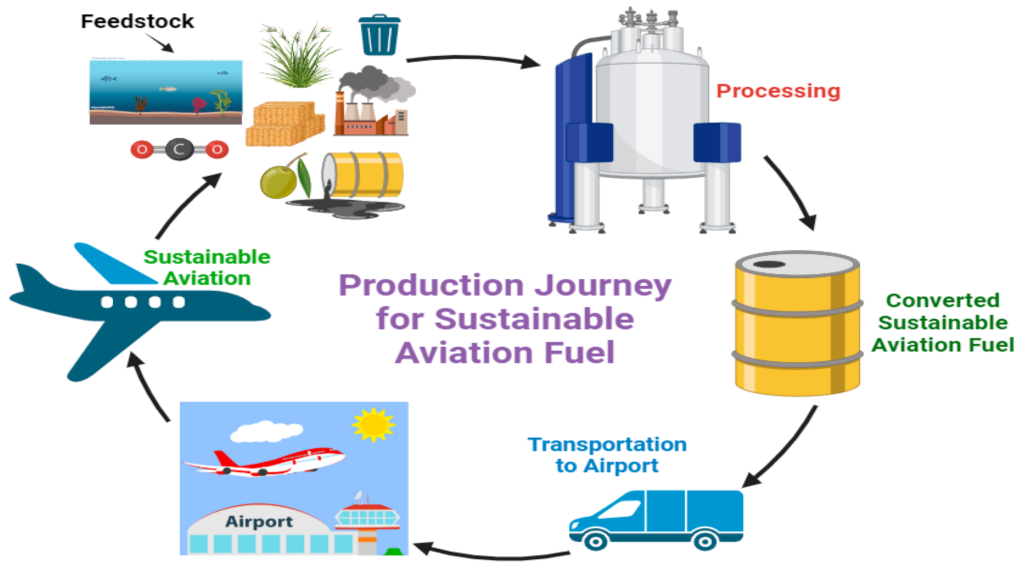
SAF is an alternative to conventional petroleum-based jet fuel. It can be made from a range of renewable or waste-derived materials, including used cooking oil, agricultural residues, municipal waste, algae, and other biomasses. One of SAF’s biggest advantages is that it is a “drop-in” fuel: it can be blended with conventional jet fuel and used in existing aircraft engines and airport fuel systems without requiring major changes to planes or infrastructure.
That compatibility matters. Aviation is a global system, and solutions that work within today’s aircraft and airport networks can begin reducing emissions sooner than technologies that require entirely new fleets, engines, or fueling systems.
How Much Can SAF Reduce Emissions?
SAF is often described as reducing lifecycle greenhouse gas emissions by up to 80% compared with conventional jet fuel. “Lifecycle” is the key word. The reduction is not based only on what comes out of the aircraft engine; SAF still releases carbon dioxide when burned. Instead, lifecycle accounting looks across the full fuel pathway: sourcing the feedstock, processing it, transporting it, blending it, and finally using it in flight.
The climate benefit depends heavily on what the fuel is made from and how it is produced. Waste- and residue-based feedstocks, such as used cooking oil or forestry waste, can offer strong emissions reductions, but these materials are limited. Crop-based fuels can be more complicated to measure because of land use considerations, deforestation risk, food competition, fertilizer use, and other supply-chain related emissions. That is why transparency, third-party verification, and strong sustainability standards are essential.
Why SAF Is Moving From “Green Goal” to Energy Strategy
SAF is increasingly being discussed not only as a climate solution, but also as an energy security strategy. Countries that can produce lower-carbon aviation fuels from local waste streams, renewable energy, or regional biomass may be less dependent on imported fossil fuels and volatile global fuel markets. Similar shifts have happened before with solar power, wind energy, electric vehicles, and LED lighting: what begins as an environmental innovation can become a mainstream economic and energy priority once policy, investment, and infrastructure align.
Policy is helping accelerate that shift. The European Union’s ReFuelEU Aviation rules require SAF blending to rise over time, reaching 6% by 2030, 34% by 2040, and 70% by 2050. The United Kingdom’s SAF Mandate starts at 2% in 2025 and increases to 10% by 2030 and 22% by 2040. In the United States, the SAF Grand Challenge aims to scale domestic SAF production while reducing lifecycle emissions.
These policies matter because SAF is still expensive and supply remains limited. Building a credible SAF market requires more than good intentions; it requires production facilities, sustainable feedstock supply chains, certification systems, airport distribution networks, and long-term demand from airlines, governments, and travelers.

Is SAF a Real Solution—or a Distraction?
SAF is a real solution, but it is not the only solution. The most responsible approach to travel emissions follows a familiar hierarchy: reduce what we can, improve what remains, and invest in better systems for the future.
For shorter routes, rail can be a lower-carbon alternative to flying, especially where strong train infrastructure exists. Some countries have already begun limiting short domestic flights when practical rail options are available. For longer routes, especially across oceans or to remote destinations, aviation will continue to play a role—and that is where cleaner fuels, efficient aircraft, and smarter routing become especially important.
For travel organizations with a commitment to sustainability, the message should be balanced: SAF can help reduce the carbon intensity of flying, but it should not be used to justify unnecessary emissions or vague “green” claims. It should be part of a broader commitment to climate-conscious travel, destination stewardship, and community benefit.
How Travelers Can Spot Meaningful SAF Commitments
As SAF becomes more visible in airline sustainability programs, travelers should look for substance over slogans. A credible SAF commitment should explain how much fuel is being purchased, what it is made from, how emissions reductions are calculated, and whether the claims are independently verified.
Questions to Ask Before Trusting a SAF Claim
- What feedstock is being used, and is it waste-based, residue-based, or synthetic?
- Does the fuel avoid food-crop competition and deforestation-linked supply chains?
- Is there a third-party lifecycle analysis that includes upstream emissions and land-use impacts?
- Are the claims certified through recognized sustainability systems such as ISCC or RSB?
- Is there evidence of physical SAF delivery, or is the claim based only on credits or offsets?
- Are the airline’s marketing claims proportional to the amount of SAF actually used?
Red flags include vague “net-zero” language, unverified “up to 80% reduction” claims, unclear feedstock origins, self-certified sustainability statements, and token purchases that are small compared with an airline’s total fuel use. SAF is most meaningful when it is transparent, traceable, and part of a larger decarbonization strategy.
What This Means for Sustainable Travel
The travel industry is built on movement, and movement has an environmental cost. But travel also creates connection, understanding, livelihoods, and opportunities for conservation and cultural exchange. The goal is to preserve the human value of travel while continually reducing its environmental impact.
That means reducing emissions where possible, choosing lower-carbon transportation when it makes sense, supporting cleaner aviation technologies, investing in sustainable infrastructure, and ensuring tourism benefits the people and places travelers visit. It also means being honest: SAF is promising, but it is still scaling. Today’s decisions should help build the market responsibly, not simply make travelers feel better about business as usual.
The Bottom Line
SAF is one of the most practical tools available today to reduce aviation’s carbon footprint, especially for flights that cannot easily be replaced by lower-carbon alternatives. But its impact depends on how it is produced, how quickly it scales, and how honestly the travel industry communicates its benefits and limitations.
For travelers, the path forward is not about perfection. It is about asking better questions, supporting credible climate solutions, choosing thoughtfully, and helping shape a travel industry that connects the world while taking greater responsibility for its impact on it.